 Add to Chrome
 Add to Firefox
 Add to Edge
Real-Time Generation of Streamable Talking Portrait Video with Reference-Guided Deep Compression VAEs
Jun 01, 2026
Video diffusion models have significantly advanced portrait video generation, yet their high computational demands limit their use in interactive applications. This work presents a framework for streamable talking portrait video generation conditioned on speech audio and reference images. Designed meticulously for streaming scenarios, it features a causal video VAE for deep latent compression and an autoregressive latent denoising model. Our causal VAE integrates a variable number of reference images as guidance, allowing the network to focus on dynamic information rather than static appearance, thereby enhancing compression efficacy and reconstruction quality. Additionally, we extend the residual auto-encoding paradigm to improve spatial-temporal causality handling in our VAE. The generator is based on a Rectified Flow Transformer architecture and produces video latents in a blockwise auto-regressive manner. Our method enables the real-time generation of high-quality talking portrait videos, achieving speeds significantly faster than baseline models. Furthermore, comprehensive experiments demonstrate that it is on par with or even outperforms these large models in realism, vividness, and video quality.

Beyond Voxel 3D Editing: Learning from 3D Masks and Self-Constructed Data
Apr 15, 20263D editing refers to the ability to apply local or global modifications to 3D assets. Effective 3D editing requires maintaining semantic consistency by performing localized changes according to prompts, while also preserving local invariance so that unchanged regions remain consistent with the original. However, existing approaches have significant limitations: multi-view editing methods incur losses when projecting back to 3D, while voxel-based editing is constrained in both the regions that can be modified and the scale of modifications. Moreover, the lack of sufficiently large editing datasets for training and evaluation remains a challenge. To address these challenges, we propose a Beyond Voxel 3D Editing (BVE) framework with a self-constructed large-scale dataset specifically tailored for 3D editing. Building upon this dataset, our model enhances a foundational image-to-3D generative architecture with lightweight, trainable modules, enabling efficient injection of textual semantics without the need for expensive full-model retraining. Furthermore, we introduce an annotation-free 3D masking strategy to preserve local invariance, maintaining the integrity of unchanged regions during editing. Extensive experiments demonstrate that BVE achieves superior performance in generating high-quality, text-aligned 3D assets, while faithfully retaining the visual characteristics of the original input.
HiSpatial: Taming Hierarchical 3D Spatial Understanding in Vision-Language Models
Mar 26, 2026Achieving human-like spatial intelligence for vision-language models (VLMs) requires inferring 3D structures from 2D observations, recognizing object properties and relations in 3D space, and performing high-level spatial reasoning. In this paper, we propose a principled hierarchical framework that decomposes the learning of 3D spatial understanding in VLMs into four progressively complex levels, from geometric perception to abstract spatial reasoning. Guided by this framework, we construct an automated pipeline that processes approximately 5M images with over 45M objects to generate 3D spatial VQA pairs across diverse tasks and scenes for VLM supervised fine-tuning. We also develop an RGB-D VLM incorporating metric-scale point maps as auxiliary inputs to further enhance spatial understanding. Extensive experiments demonstrate that our approach achieves state-of-the-art performance on multiple spatial understanding and reasoning benchmarks, surpassing specialized spatial models and large proprietary systems such as Gemini-2.5-pro and GPT-5. Moreover, our analysis reveals clear dependencies among hierarchical task levels, offering new insights into how multi-level task design facilitates the emergence of 3D spatial intelligence.
VASA-3D: Lifelike Audio-Driven Gaussian Head Avatars from a Single Image
Dec 16, 2025We propose VASA-3D, an audio-driven, single-shot 3D head avatar generator. This research tackles two major challenges: capturing the subtle expression details present in real human faces, and reconstructing an intricate 3D head avatar from a single portrait image. To accurately model expression details, VASA-3D leverages the motion latent of VASA-1, a method that yields exceptional realism and vividness in 2D talking heads. A critical element of our work is translating this motion latent to 3D, which is accomplished by devising a 3D head model that is conditioned on the motion latent. Customization of this model to a single image is achieved through an optimization framework that employs numerous video frames of the reference head synthesized from the input image. The optimization takes various training losses robust to artifacts and limited pose coverage in the generated training data. Our experiment shows that VASA-3D produces realistic 3D talking heads that cannot be achieved by prior art, and it supports the online generation of 512x512 free-viewpoint videos at up to 75 FPS, facilitating more immersive engagements with lifelike 3D avatars.
Native and Compact Structured Latents for 3D Generation
Dec 16, 2025Recent advancements in 3D generative modeling have significantly improved the generation realism, yet the field is still hampered by existing representations, which struggle to capture assets with complex topologies and detailed appearance. This paper present an approach for learning a structured latent representation from native 3D data to address this challenge. At its core is a new sparse voxel structure called O-Voxel, an omni-voxel representation that encodes both geometry and appearance. O-Voxel can robustly model arbitrary topology, including open, non-manifold, and fully-enclosed surfaces, while capturing comprehensive surface attributes beyond texture color, such as physically-based rendering parameters. Based on O-Voxel, we design a Sparse Compression VAE which provides a high spatial compression rate and a compact latent space. We train large-scale flow-matching models comprising 4B parameters for 3D generation using diverse public 3D asset datasets. Despite their scale, inference remains highly efficient. Meanwhile, the geometry and material quality of our generated assets far exceed those of existing models. We believe our approach offers a significant advancement in 3D generative modeling.
Scalable Vision-Language-Action Model Pretraining for Robotic Manipulation with Real-Life Human Activity Videos
Oct 24, 2025


This paper presents a novel approach for pretraining robotic manipulation Vision-Language-Action (VLA) models using a large corpus of unscripted real-life video recordings of human hand activities. Treating human hand as dexterous robot end-effector, we show that "in-the-wild" egocentric human videos without any annotations can be transformed into data formats fully aligned with existing robotic V-L-A training data in terms of task granularity and labels. This is achieved by the development of a fully-automated holistic human activity analysis approach for arbitrary human hand videos. This approach can generate atomic-level hand activity segments and their language descriptions, each accompanied with framewise 3D hand motion and camera motion. We process a large volume of egocentric videos and create a hand-VLA training dataset containing 1M episodes and 26M frames. This training data covers a wide range of objects and concepts, dexterous manipulation tasks, and environment variations in real life, vastly exceeding the coverage of existing robot data. We design a dexterous hand VLA model architecture and pretrain the model on this dataset. The model exhibits strong zero-shot capabilities on completely unseen real-world observations. Additionally, fine-tuning it on a small amount of real robot action data significantly improves task success rates and generalization to novel objects in real robotic experiments. We also demonstrate the appealing scaling behavior of the model's task performance with respect to pretraining data scale. We believe this work lays a solid foundation for scalable VLA pretraining, advancing robots toward truly generalizable embodied intelligence.
Gaussian Variation Field Diffusion for High-fidelity Video-to-4D Synthesis
Jul 31, 2025In this paper, we present a novel framework for video-to-4D generation that creates high-quality dynamic 3D content from single video inputs. Direct 4D diffusion modeling is extremely challenging due to costly data construction and the high-dimensional nature of jointly representing 3D shape, appearance, and motion. We address these challenges by introducing a Direct 4DMesh-to-GS Variation Field VAE that directly encodes canonical Gaussian Splats (GS) and their temporal variations from 3D animation data without per-instance fitting, and compresses high-dimensional animations into a compact latent space. Building upon this efficient representation, we train a Gaussian Variation Field diffusion model with temporal-aware Diffusion Transformer conditioned on input videos and canonical GS. Trained on carefully-curated animatable 3D objects from the Objaverse dataset, our model demonstrates superior generation quality compared to existing methods. It also exhibits remarkable generalization to in-the-wild video inputs despite being trained exclusively on synthetic data, paving the way for generating high-quality animated 3D content. Project page: https://gvfdiffusion.github.io/.
MoGe-2: Accurate Monocular Geometry with Metric Scale and Sharp Details
Jul 03, 2025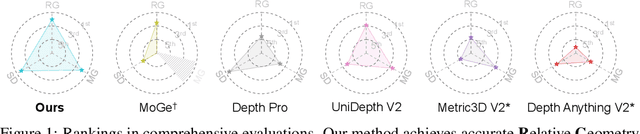
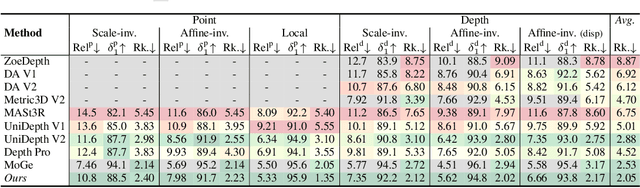
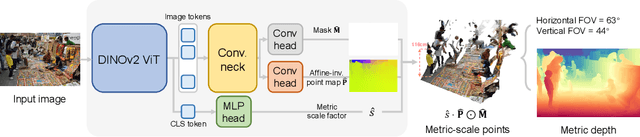
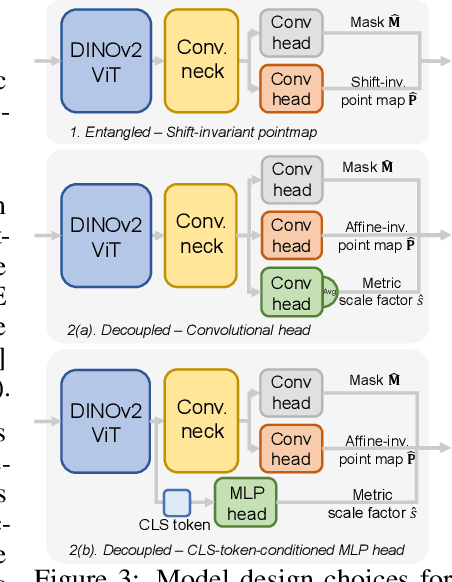
We propose MoGe-2, an advanced open-domain geometry estimation model that recovers a metric scale 3D point map of a scene from a single image. Our method builds upon the recent monocular geometry estimation approach, MoGe, which predicts affine-invariant point maps with unknown scales. We explore effective strategies to extend MoGe for metric geometry prediction without compromising the relative geometry accuracy provided by the affine-invariant point representation. Additionally, we discover that noise and errors in real data diminish fine-grained detail in the predicted geometry. We address this by developing a unified data refinement approach that filters and completes real data from different sources using sharp synthetic labels, significantly enhancing the granularity of the reconstructed geometry while maintaining the overall accuracy. We train our model on a large corpus of mixed datasets and conducted comprehensive evaluations, demonstrating its superior performance in achieving accurate relative geometry, precise metric scale, and fine-grained detail recovery -- capabilities that no previous methods have simultaneously achieved.
Structured 3D Latents for Scalable and Versatile 3D Generation
Dec 02, 2024
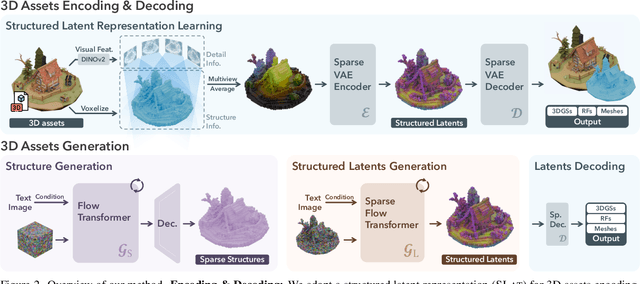
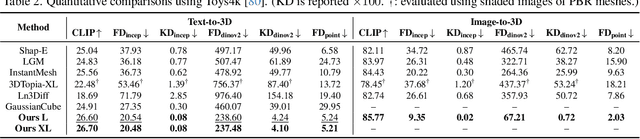

We introduce a novel 3D generation method for versatile and high-quality 3D asset creation. The cornerstone is a unified Structured LATent (SLAT) representation which allows decoding to different output formats, such as Radiance Fields, 3D Gaussians, and meshes. This is achieved by integrating a sparsely-populated 3D grid with dense multiview visual features extracted from a powerful vision foundation model, comprehensively capturing both structural (geometry) and textural (appearance) information while maintaining flexibility during decoding. We employ rectified flow transformers tailored for SLAT as our 3D generation models and train models with up to 2 billion parameters on a large 3D asset dataset of 500K diverse objects. Our model generates high-quality results with text or image conditions, significantly surpassing existing methods, including recent ones at similar scales. We showcase flexible output format selection and local 3D editing capabilities which were not offered by previous models. Code, model, and data will be released.
CogACT: A Foundational Vision-Language-Action Model for Synergizing Cognition and Action in Robotic Manipulation
Nov 29, 2024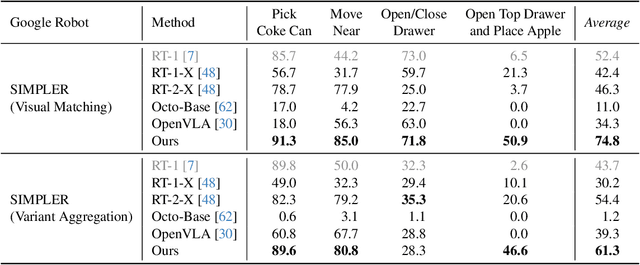

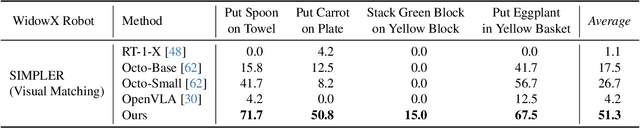

The advancement of large Vision-Language-Action (VLA) models has significantly improved robotic manipulation in terms of language-guided task execution and generalization to unseen scenarios. While existing VLAs adapted from pretrained large Vision-Language-Models (VLM) have demonstrated promising generalizability, their task performance is still unsatisfactory as indicated by the low tasks success rates in different environments. In this paper, we present a new advanced VLA architecture derived from VLM. Unlike previous works that directly repurpose VLM for action prediction by simple action quantization, we propose a omponentized VLA architecture that has a specialized action module conditioned on VLM output. We systematically study the design of the action module and demonstrates the strong performance enhancement with diffusion action transformers for action sequence modeling, as well as their favorable scaling behaviors. We also conduct comprehensive experiments and ablation studies to evaluate the efficacy of our models with varied designs. The evaluation on 5 robot embodiments in simulation and real work shows that our model not only significantly surpasses existing VLAs in task performance and but also exhibits remarkable adaptation to new robots and generalization to unseen objects and backgrounds. It exceeds the average success rates of OpenVLA which has similar model size (7B) with ours by over 35% in simulated evaluation and 55% in real robot experiments. It also outperforms the large RT-2-X model (55B) by 18% absolute success rates in simulation. Code and models can be found on our project page (https://cogact.github.io/).